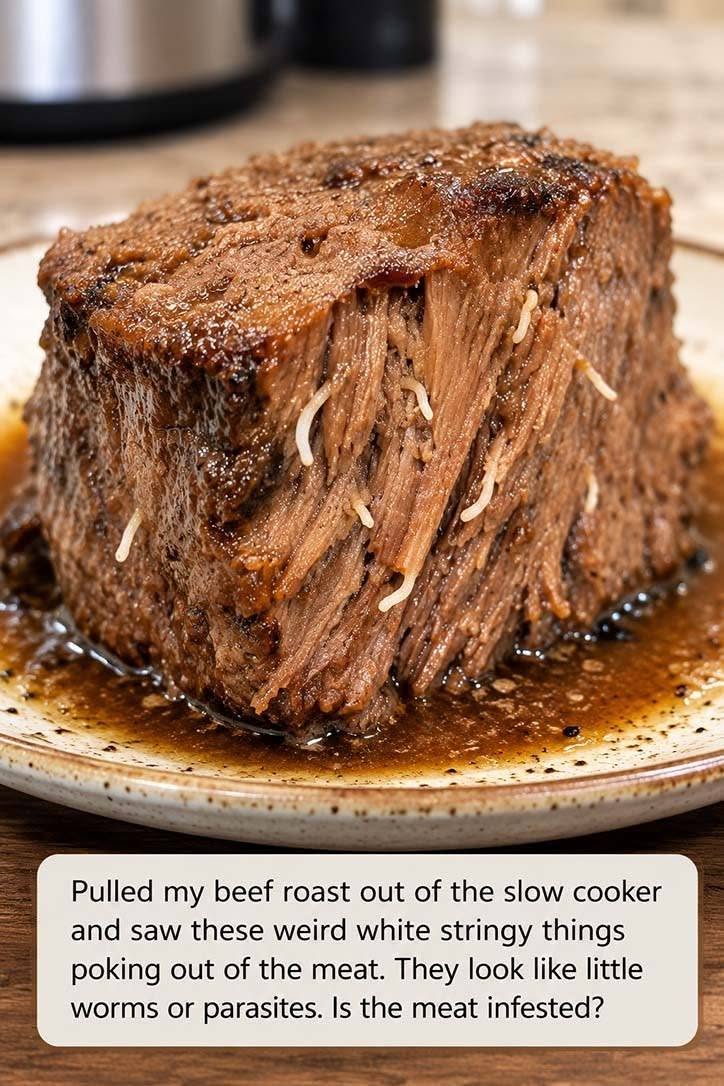
Food photographs can be surprisingly deceptive.
Take a close-up picture of a thin strand of connective tissue, crop out the rest of the roast, and suddenly it can look much more alarming than it did on the dinner table.
Add a caption asking:
“IS MY MEAT INFESTED?”
and thousands of people may immediately assume the worst.
This is one reason food-safety questions shouldn’t be answered solely by viral comments.
The physical condition of the food, its storage history, cooking method, temperature, source, smell, and texture all provide useful context that a photograph cannot fully capture.
When You Probably Don’t Need to Panic
If you bought the beef from a reputable source, stored and thawed it correctly, cooked it appropriately, and the roast otherwise looks and smells normal, pale irregular strands that appear integrated into the meat may simply be connective tissue exposed during cooking.
This is especially plausible in connective-tissue-rich cuts cooked for several hours.
The appearance can certainly be unpleasant if you’ve never seen it before.
But unfamiliar doesn’t automatically mean dangerous.
When You Should Be More Cautious
Stop and investigate further if something genuinely seems abnormal.
Examples include meat with obvious spoilage signs, questionable storage history, severely damaged packaging before cooking, or a structure that looks clearly separate and unlike ordinary fat or connective tissue.
Also be cautious if you don’t know where the meat came from or how it was handled.
If you’re genuinely uncertain, don’t eat it merely because someone online says, “It’s definitely collagen.”
A butcher, food-safety authority, or other qualified professional may be able to provide better guidance depending on the situation.
Can You Simply Cut the White Strings Away?
If you’ve established that what you’re seeing is ordinary connective tissue or fat, removing it becomes a matter of preference rather than necessity.
Some people enjoy the rich gelatinous texture.
Others don’t.
You can pull away any pieces you find unpleasant and serve the remaining meat.
There’s nothing wrong with having a texture preference.
Why the Cooking Liquid May Turn Gelatinous
There’s another surprise that sometimes concerns people after making roast beef.
Place leftover cooking juices in the refrigerator and you may discover that the liquid has turned into something resembling jelly.
That can be perfectly consistent with gelatin produced during the breakdown of collagen.
When chilled, gelatin-rich cooking liquid can become noticeably firm.
Once reheated, it generally becomes liquid again.
This property is one reason slow-cooked stocks, broths, and braising liquids can develop such a rich mouthfeel.
What If You See the White Material Before Cooking?
Raw beef also contains visible connective tissue and fat.
Silvery membranes, pale seams, and white bands running through a roast can all be normal anatomical structures.
Some tougher exterior connective tissue—often referred to in cooking as “silverskin”—may be trimmed depending on the cut and recipe.
Visible fat can also be trimmed according to preference.
However, if you see something in raw meat that genuinely looks abnormal rather than like ordinary tissue, don’t simply assume slow cooking will make the problem disappear.
Ask the butcher or retailer, or avoid using the meat if its safety is genuinely questionable.
A Simple Checklist Before Eating Your Roast
Continued on next page: