Raw meat is tightly structured.
During cooking, muscle proteins change, moisture is lost, connective tissue softens, and the overall structure of the roast changes.
Once you begin pulling the tender meat apart, connective tissue that was previously hidden can become exposed.
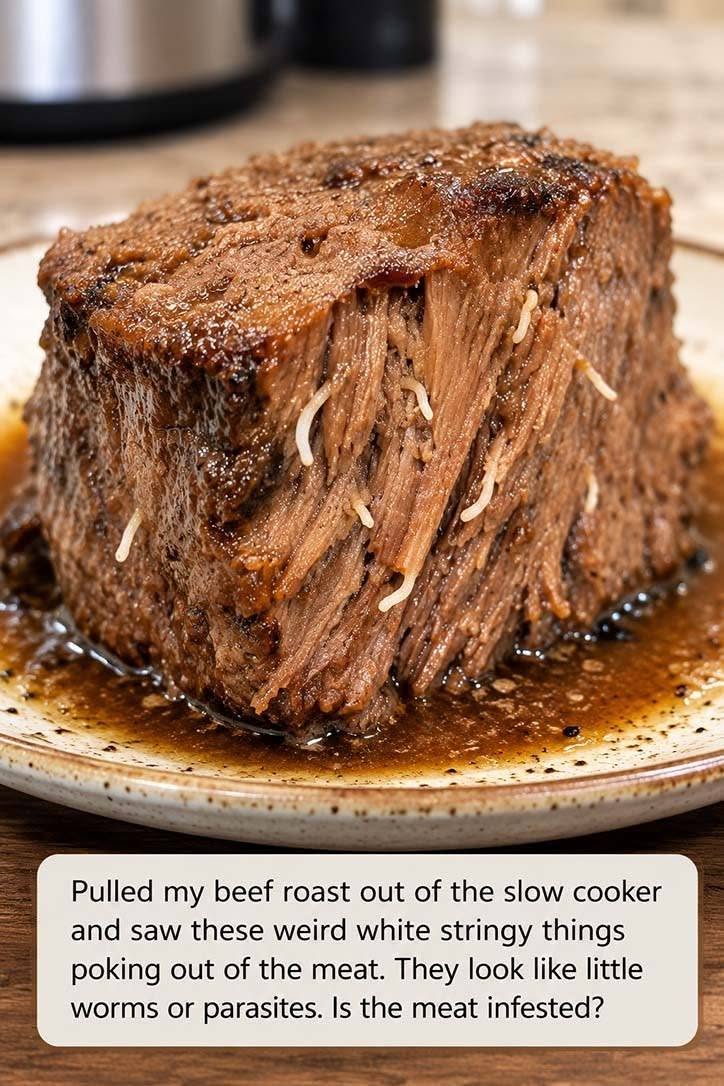
A thin strand surrounded by shredded beef can look remarkably biological when viewed out of context.
But something looking like a worm does not automatically make it a parasite.
Connective Tissue or Parasite?
This is the question most people want answered.
Unfortunately, photographs and descriptions aren’t always enough to identify every unusual structure in meat with certainty.
Normal connective tissue tends to be integrated into the structure of the meat rather than appearing as an independent organism.
After prolonged cooking, it may be soft, stretchy, slippery, gelatinous, or easy to pull apart.
You may also see multiple irregular strands running along natural separations between muscle fibers.
That appearance is compatible with connective tissue.
A genuinely unusual structure that is clearly distinct from the surrounding meat deserves more caution.
If you cannot confidently identify what you’re seeing, don’t rely on an internet photograph or social-media comment to decide that the meat is safe.
Are Parasites Possible in Beef?
Parasites associated with cattle do exist.
So it would be inaccurate to claim that parasites in beef are literally impossible.
Food inspection, commercial processing, proper storage, and proper cooking all play important roles in reducing food-safety risks.
This is also why buying meat from reputable, regulated sources matters.
The mistake is going to either extreme.
You shouldn’t assume every white strand is a parasite.
But you also shouldn’t declare every unusual object in meat to be harmless collagen without considering the rest of the evidence.
Look at the Meat Before Cooking
The condition of the roast before it enters the slow cooker can tell you a lot.
If raw beef has an obvious unpleasant or abnormal odor, unusual sliminess, or other convincing signs of spoilage, cooking it for several hours isn’t a sensible way to rescue it.
Cooking can destroy many microorganisms when appropriate temperatures are reached, but cooking isn’t a magical reset button for spoiled food.
When meat clearly appears spoiled before cooking, the safer choice is to discard it.
Storage History Matters
How the meat was handled before cooking is extremely important.
Raw beef should be kept refrigerated or frozen appropriately.
Leaving meat at unsafe temperatures for extended periods can allow microorganisms to multiply.
That risk cannot be evaluated simply by looking at a finished roast.
Think about where the beef came from, how it was transported, whether it remained cold, how long it was refrigerated, and whether it was thawed safely.
A normal appearance doesn’t compensate for clearly unsafe storage.
What About the Smell?
Continued on next page: