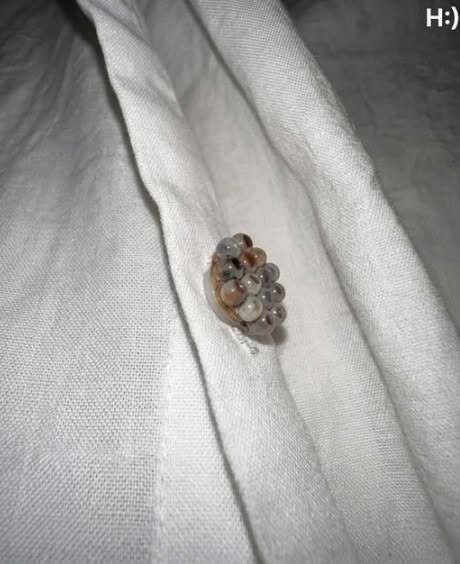
Ticks lay eggs in large groups.
However, tick eggs are generally much smaller and are almost never deposited directly on bedding inside a home.
Most ticks prefer outdoor environments with leaves, soil, or vegetation.
Again, it didn’t seem like a match.
The Real Answer
After comparing dozens of photos and consulting reliable identification resources, the mystery became much clearer.
The tiny balls in the picture strongly resemble the eggs of a stink bug or another shield bug species.
Stink bug eggs are often:
Nearly spherical
Arranged in tight clusters
Gray, cream, green, or light brown
Attached together in organized patterns
Many species lay between twenty and thirty eggs at one time.
Depending on the species and stage of development, the eggs can appear in slightly different colors.
Some even develop darker markings just before hatching.
Although stink bugs usually lay eggs outdoors on the underside of leaves, clusters occasionally end up indoors after being carried inside on clothing, plants, outdoor furniture, pets, or other objects.
In some cases, an adult insect that accidentally enters a house may also lay eggs on unusual indoor surfaces.
Are They Dangerous?
The good news is that stink bug eggs are generally not dangerous to people.
Unlike bed bugs:
They do not bite humans.
They do not feed on blood.
They are not known for spreading disease inside homes.
They don’t infest mattresses the way bed bugs do.
The biggest concern comes if the eggs hatch.
Young stink bugs, called nymphs, may wander around looking for food or a way outdoors.
While they’re considered agricultural pests because they feed on plants and crops, they’re far less concerning inside a home than many other household insects.
What Should You Do If You Find Them?
If you discover a similar cluster, avoid crushing it directly with your fingers.
Adult stink bugs are famous for releasing a strong, unpleasant odor when threatened or crushed.
Although the eggs themselves usually don’t produce the smell, it’s still best to remove them carefully.
Here are a few simple steps:
1. Collect the cluster carefully.
Use a piece of stiff paper, tape, or a tissue to lift the eggs.
2. Seal them.
Place them inside a sealed plastic bag or airtight container before disposing of them.
3. Inspect nearby areas.
Check windows, curtains, houseplants, and nearby furniture for additional clusters.
4. Clean the surface.
Wipe the area with soap and water or a household disinfectant.
5. Watch for insects.
Over the following days, keep an eye out for small shield-shaped bugs near windows or light sources.
How Did They End Up Indoors?
This is one of the most common questions people ask.
There are several possibilities.
They Came in on Plants
Houseplants and freshly cut flowers sometimes carry insect eggs without anyone noticing.
Since many egg clusters are attached to leaves, they’re easy to overlook.
They Hitchhiked on Clothing
If you’ve spent time gardening, hiking, or working outdoors, insects or their eggs may accidentally cling to clothing or bags.
Open Windows
During warmer months, many insects enter homes through open windows, especially at night when indoor lights attract them.
Outdoor Furniture
Blankets, cushions, or pillows left outside may occasionally collect insects or eggs before being brought back indoors.
Why So Many People Panic
Finding unfamiliar eggs in your home immediately triggers concern because many people associate any insect eggs with infestations.
The internet often makes this fear even worse.
One alarming image leads to another.
Suddenly, every search result seems to point toward the most frightening possibility.
In reality, many insects occasionally wander indoors without creating long-term problems.
Correct identification is always the first step before assuming the worst.
Other Egg Clusters That Can Be Mistaken for These
Several insect species lay eggs that appear similar at first glance.
Ladybug Eggs
Ladybug eggs are usually bright yellow or orange and shaped more like tiny capsules.
Lacewing Eggs
Lacewing eggs are unique because each one sits on top of a thin, hair-like stalk.
Moth Eggs
Moth eggs tend to be much smaller and are often hidden on fabrics or stored food depending on the species.
Butterfly Eggs
Butterfly eggs vary greatly in shape but are usually laid on specific host plants rather than bedding.
Snail Eggs
Snail eggs are translucent and jelly-like, usually found in moist soil rather than indoors.
Careful observation usually reveals important differences.
Preventing Future Surprises
Although finding a single egg cluster doesn’t necessarily indicate a serious problem, there are several simple ways to reduce the chances of insects entering your home.
Inspect plants before bringing them indoors.
Repair damaged window screens.
Seal cracks around doors and windows.
Vacuum regularly, especially near windowsills.
Reduce outdoor lighting near open windows at night.
Store outdoor cushions and blankets indoors when not in use.
These small habits can greatly reduce the number of insects that accidentally make their way inside.
When Should You Be Concerned?
Most isolated egg clusters are not an emergency.
However, you should consider contacting a pest-control professional if:
You repeatedly find new egg clusters.
You notice large numbers of insects indoors.
You suspect bed bugs, termites, or cockroaches.
You begin finding insect damage throughout your home.
An expert can identify the species and determine whether additional treatment is necessary.
The Lesson I Learned
Looking back, I realize how quickly fear can take over when we encounter something unfamiliar.
For a few minutes, I convinced myself that my bedroom was the site of a major insect infestation.
The reality turned out to be much less dramatic.
The mysterious little balls were most likely an egg cluster from a harmless visitor that had somehow found its way indoors.
The experience reminded me that curiosity is often more helpful than panic.
Instead of assuming the worst, taking a clear photo, comparing reliable sources, and carefully inspecting the situation can save a great deal of unnecessary stress.
So, if you ever discover a strange cluster of tiny balls on your bedding, furniture, or windowsill, don’t immediately assume disaster has struck. While it’s always wise to investigate, many mysterious household discoveries have simple explanations. A calm, careful approach is the best way to determine what you’re dealing with and decide whether any action is truly needed.
Sometimes, the scariest-looking mysteries turn out to be nothing more than a small reminder that nature has a way of surprising us—even in the comfort of our own homes.