Brain teasers have remained popular for generations because they challenge the way we think rather than simply testing what we know. While some puzzles require mathematical skills or advanced logic, others depend entirely on paying close attention to the words being used. One of the most widely shared riddles online is a perfect example. It looks incredibly easy, yet thousands of people arrive at the wrong answer within seconds.
Take a moment to read the following question carefully before looking at the solution.
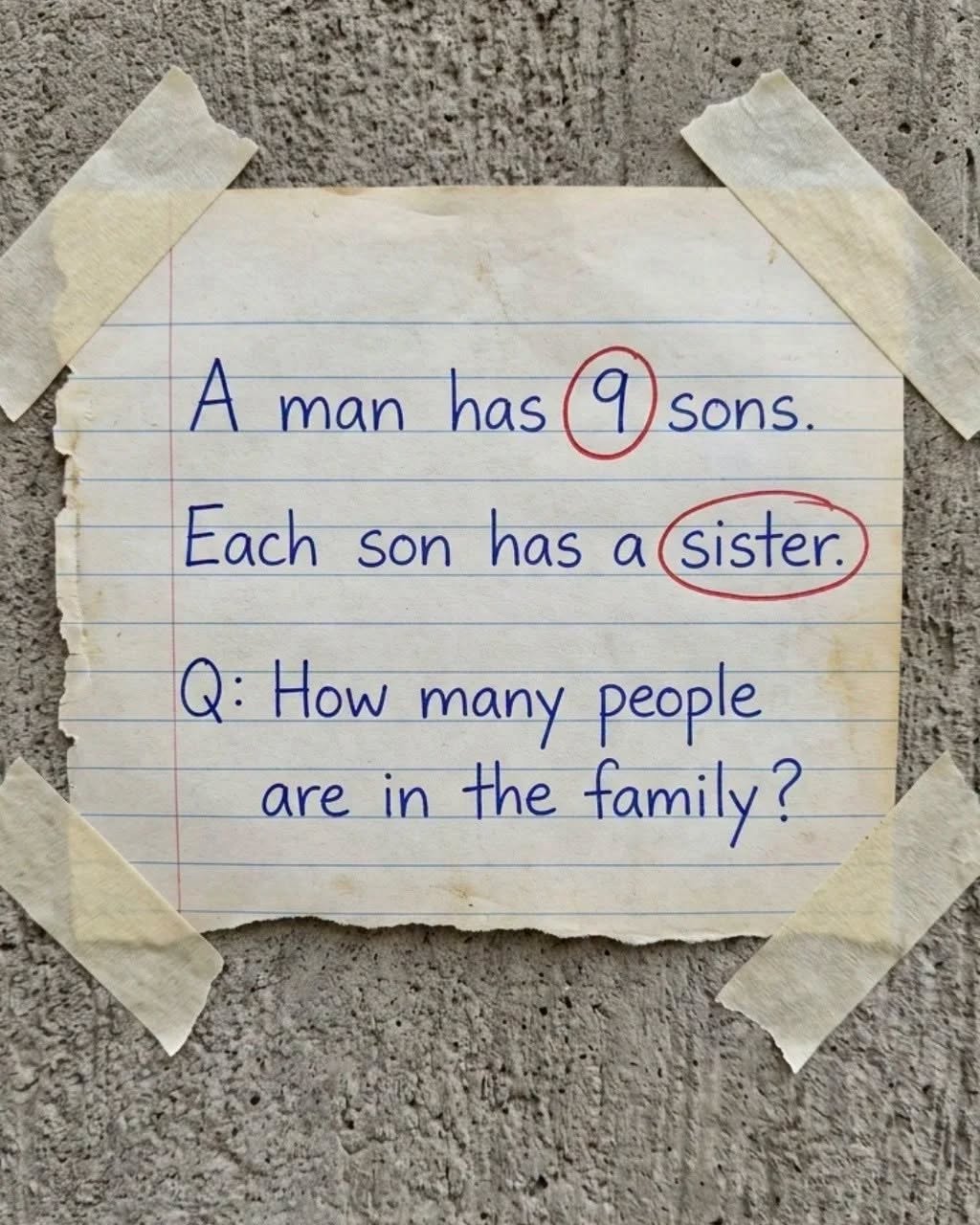
A man has 9 sons. Each son has a sister. How many people are in the family?
At first glance, the answer may seem obvious. Many people immediately begin calculating in their heads. They count the father, add the nine sons, and then assume each son has his own sister. That leads them to add another nine girls, producing a total of 19 people.
Although this answer seems reasonable, it is based on an assumption that the riddle never actually makes.
The secret lies in reading every word carefully instead of rushing to a conclusion. The statement says that each son has a sister, but it never says that each son has a different sister. In fact, all nine brothers could share the same sister.
Once you notice this detail, the puzzle becomes much simpler.
The family consists of one father, nine sons, and one daughter who is the sister of all nine boys.
Adding them together gives the correct total of 11 people.
This small difference in wording is what makes the riddle so effective. Our brains naturally look for patterns and often fill in missing information without us realizing it. When we read the phrase “each son has a sister,” many people automatically imagine nine separate sisters because it feels like the most obvious interpretation. However, the sentence never states that.